Blog / Why Kitchen Design Is One of the Most Promising Careers in Interior Design
Tuesday, 18 Aug 2026
Why Kitchen Design Is One of the Most Promising Careers in Interior Design
The kitchen has quietly walked off the sidelines and into the spotlight, becoming the centrepiece of every home makeover show and the deciding factor in real estate listings. A career in interior design has always drawn creative minds, but one specialisation is now pulling distinctly ahead of the rest: kitchen design. Today's kitchen designer does far more than pick tiles and cabinet finishes; they engineer how a family cooks, stores, hosts, and lives. India's interior design market is valued at close to USD 35 billion in 2026 and is on track to nearly double to roughly USD 65 billion by 2031, per Mordor Intelligence, and the modular kitchen segment within it is growing meaningfully faster than the industry average. That gap is the single most telling number in the room.
What Is Kitchen Design?
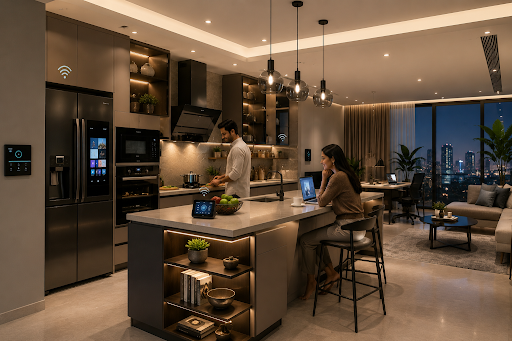
Kitchen design, at its simplest, is the discipline of planning a space that looks good and performs even better under daily pressure. Designing a modular kitchen isn't a decorating exercise; it means solving for storage, workflow, and ventilation together, so every inch of counter and cabinet earns its place before a finish is chosen. Modern kitchen designers spend as much time on utility planning (where the stove, sink, and fridge sit in relation to each other) as on the design elements that make a kitchen feel warm and lived-in rather than showroom-perfect.
Layout choices carry real weight too. L-shaped kitchens currently hold a commanding 57 percent revenue share of India's kitchen design market, prized for using corner space well in mid-sized homes, while parallel and galley layouts are the fastest-growing format, expanding at a projected CAGR of over 24 percent through 2031 as apartments shrink and buyers demand tighter footprints. Manufacturers have responded with parallel-ready module sets built to fit 8- to 10-foot walls, a shift that sums up exactly what a kitchen designer is now paid to solve.
Why Kitchen Design Is Growing Rapidly

Kitchens have stopped being rooms people cook in and leave. They've become the place families gather, entertain, help with homework, and increasingly, work from, a shift that has fuelled demand for home automation systems built into cabinetry, customized storage solutions that adapt to smaller footprints, and contemporary designs that fit how people actually live rather than how a showroom photographs. India's modular kitchen market reflects this appetite directly: it's projected to more than double between 2026 and 2031 at over 21 percent CAGR, making it one of the strongest interior design trends in the country. Designers who understand this shift are becoming genuinely harder to replace.
Why Kitchen Design Is One of the Most Promising Careers in Interior Design
Kitchen design sits at a rare intersection of creativity and technical rigour, rewarding people who can do both well. Beyond selecting colours and finishes, a designer is expected to improve storage optimization, streamline daily workflow, coordinate plumbing and electrical placement, and still deliver a space that photographs beautifully. That difficulty is the opportunity: India's interior design industry is staring down a projected shortage of nearly 1.2 million skilled professionals, per National Skill Development Corporation estimates, and kitchen specialists are among the hardest roles to fill. Modular kitchen manufacturers and independent design firms are expanding steadily, so a well-built kitchen design career rarely stays short of opportunity.
Essential Skills Every Kitchen Designer Needs
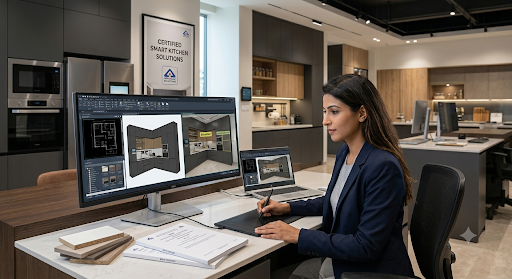
Succeeding in this field starts with strong interior design skills (proportion, material knowledge, spatial planning), but that foundation alone won't carry a career far. Kitchen design software is non-negotiable now, since most professional planning happens on screen before a panel is cut. A good designer also needs a current read on modern lifestyles, since families cook, host, and store things differently than they did a decade ago. Comfort with visualization tools closes the gap between a client's imagination and the finished space, often the difference between an approved pitch and a shelved one.
Career Opportunities in Kitchen Design
The paths out of a kitchen design education branch in different directions. Many professionals begin as a kitchen design consultant, working directly with homeowners on layout and material choices before scaling up. Others step into a modular kitchen designer role with established brands, handling residential and commercial work at real volume. Freelance kitchen design jobs are climbing too, as developers bundle ready-made kitchens into new apartment sales.
How a Professional Kitchen Design Course Can Help
Raw talent can get someone started in this field, but structured training is what compresses years of trial and error into months. A well-built kitchen design course brings the technical, creative, and commercial sides of the job together: layout science, software fluency, client psychology, vendor coordination. That structure matters more than it might seem: only an estimated 23 percent of practicing interior designers in India hold formal qualifications, according to the Council of Architecture, which is exactly the gap that structured training closes. It gives an interior designer with focused kitchen training a real edge in a crowded market, and for anyone building a long kitchen design career, that head start compounds fast.
Build Your Career with Dreamzone's Certificate Course in Kitchen Design
For anyone ready to turn a genuine interest in kitchens into a real interior design career, Dreamzone's Certificate Course in Kitchen Design is built around industry ready skills rather than theory. It covers layout planning, material selection, and the design software professionals actually use, tied to how manufacturers and design firms operate on the ground.
Conclusion
Kitchen design earns serious consideration as a career path because it combines steady demand with creative freedom and hard practical skill, genuinely rare across the wider design world. The market data, the layout shifts, and the widening skills gap all point the same way: kitchens are where interior design's growth is concentrated. A solid kitchen design course could well be the first real step toward a career that keeps evolving as fast as homes do.
Frequently Asked Questions


Corporate Headquarters
No. 25, Dr. Radhakrishnan Salai, Mylapore,
Chennai - 600 004, Tamil Nadu, India.
+91 98843 85048


Flagship Events
Trending Courses
Fashion Design
Interior Design