Blog / Why Graphic Design Is Becoming One of the Most Valuable Skills
Wednesday, 9 Sep 2026
Why Graphic Design Is Becoming One of the Most Valuable Skills
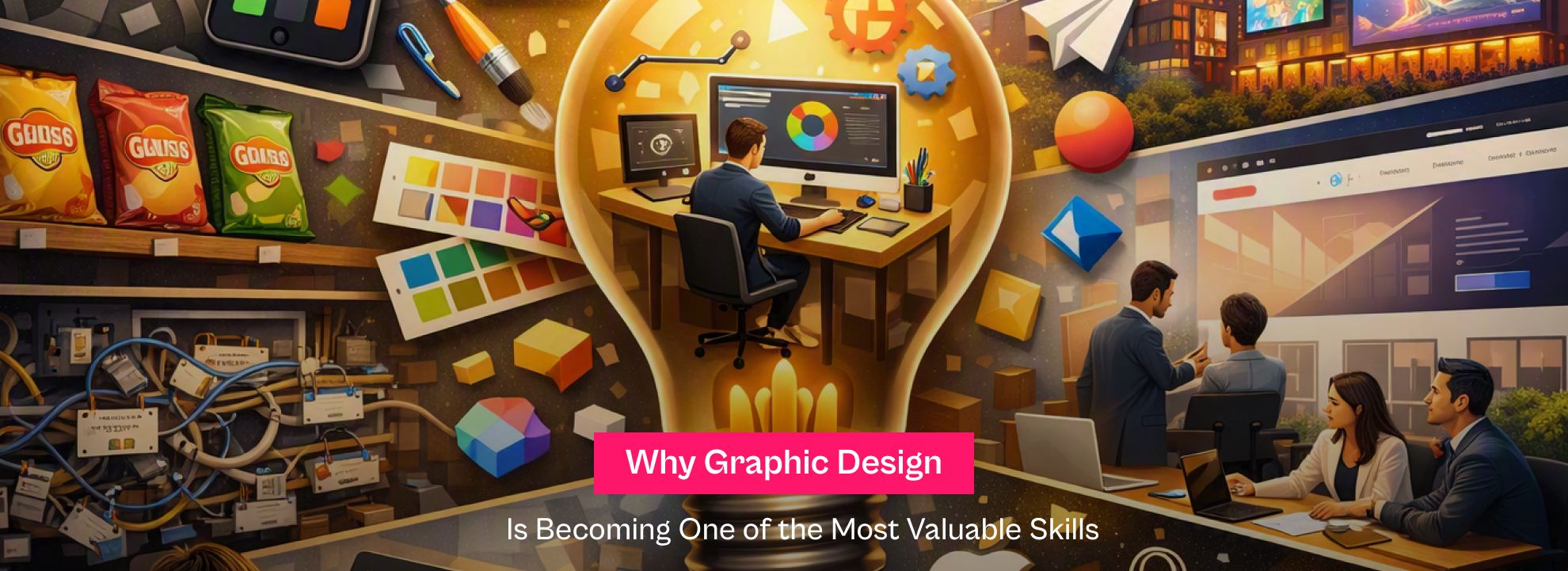
Look around you right now. The app on your phone, the poster on the wall, the packet of chips on your table, someone designed all of it. Every colour, every font, every little icon was a choice someone made. That someone was a graphic designer.
We don't always notice design when it's good. We only notice it when it's bad, a confusing app, a boring poster nobody stops to read, a website that feels like a maze. That's the secret of this field. Good design needs sharp visual thinking, the ability to look at a problem and solve it with colour, shape, and layout instead of words. When you're great at it, you become invisible. And when you're really great at it, brands can't survive without you.
That's exactly why the graphic design industry has quietly grown into something much bigger than most people realise, and why more students, and even working professionals, are picking it up today. Not because it's trendy, but because it has become one of the most useful skills a person can have, especially as more of our lives move onto digital platforms.
Why Students Are Choosing Graphic Design as a Career ?
Ask any student what they enjoyed most in school, and a good number will say art class, or making posters for the annual day, or designing the school magazine cover. A graphic design career lets you turn that same joy into an actual profession.
Here's what makes it attractive. You don't need to wait years to see the result of your work. You design something today, and it can go live on a website or a social media page tomorrow. Compare that to many other careers where you wait a long time to see your work make an impact.
It's also a wide field, not a narrow one. You could work on brand design, building the logos and visuals that make a company recognisable, or move into ui ux design, shaping how apps and websites feel to actually use. There are plenty of graphic design opportunities across both, so there's room to explore and find what excites you the most.
Why the Demand for Graphic Designers Is Growing?
Every business today, big or small, needs to look good online. A shop selling handmade candles needs website graphics. A food brand needs product creatives for its packets. A college needs social media content to reach students. None of this happens without a designer.
This is why the graphic design market has grown into a genuinely massive industry. It's expected to touch around 59 billion dollars globally in 2026, and is projected to grow to about 85 billion dollars by 2031. That's not a small trend, that's an entire industry expanding year after year.
And here's an interesting detail for Indian students especially. The Asia Pacific region, which includes India, is growing faster than any other part of the world in this space, thanks to the boom in start ups, online shopping, and digital businesses. In simple words, the opportunities are growing right here, not just abroad.
Brand identity work alone makes up a huge chunk of this industry. Whenever a company wants people to recognise it instantly, whether through a logo, colours, or a consistent look, that's a designer's job.
AI Has Changed the Industry, But Designers Are Still Important
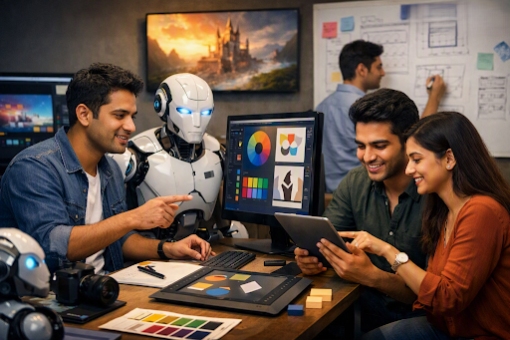
Let's talk about the elephant in the room. AI in graphic design can now generate images in seconds. So does that mean designers are no longer needed?
Not really. Even the smartest ai graphic design tools are just that, tools, like a calculator is a tool for a mathematician. They can speed up small tasks, but they cannot understand a brand's personality, or know why a particular colour makes people trust a product, or decide what message a design should give people. That thinking still needs a human.
In fact, studies on the future of graphic design point out something interesting. Roles focused only on repeating basic tasks are slowing down, but designers who understand digital platforms, user experience, and strategy are the ones industries are hiring for the most. So the smart move isn't avoiding AI, it's learning how to use it while sharpening the skills AI cannot copy, your creativity, your taste, and your understanding of people.
Why Building a Strong Portfolio Matters?
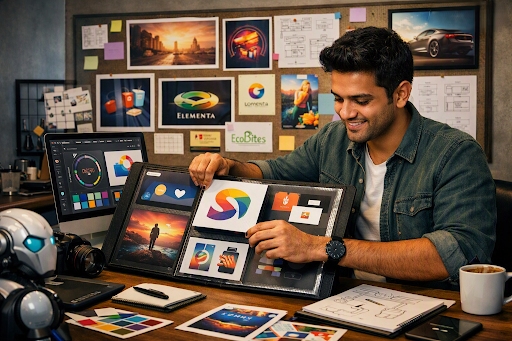
Here's something schools don't always teach, but the design world lives by: nobody asks for your marks in this field. They ask to see your graphic design portfolio.
Your portfolio is basically proof of what you can do. It could have branding projects, logo concepts, a poster you designed for fun, or a mock app screen you built just to practice. Every one of your graphic design projects, big or small, adds to this proof. The moment you start collecting these, you're building something far more powerful than a resume, you're building evidence.
This is also why it's smart to start early. Even small projects done during your course or in your free time can turn into portfolio pieces that impress a future employer or client.
Graphic Design Creates Opportunities Beyond Traditional Jobs
A lot of people still imagine graphic design as just a "design studio job." But it stretches into far more corners than that. Marketing teams, advertising agencies, ecommerce companies, film studios, gaming companies, and even hospitals need designers for their communication and branding.
The right graphic design education doesn't lock you into one type of graphic design job. It opens a door into many. It's also one of the more flexible options among creative career paths out there. Around the world, a large share of graphic designers choose to freelance rather than work a nine to five job. That means you could work with clients from different cities, or even different countries, right from your laptop.
How to Start a Career in Graphic Design?

If this sounds like something you want to try, the good news is, you don't need to figure it all out alone. When you learn graphic design, it usually starts with the basics, colour, typography, layout, and design software, before moving into specialised areas like branding or ui ux design.
The fastest and most reliable way to do this well is through a proper graphic design course, where you're taught step by step, guided by mentors, and given real projects to build your portfolio. Trying to learn everything from scattered videos online can work, but it takes much longer and it's easy to miss the fundamentals.
Why Choose Dreamzone for Graphic Design Courses?
This is where Dreamzone comes in. As a design and innovation institute working towards making India the Design and Innovation Capital of the World, Dreamzone offers among the best graphic design course options for students who want to go from the basics all the way to becoming job ready, or client ready if they choose to freelance.
You get to learn from experienced faculty, work on live projects, and walk out with a portfolio that actually says something about your skill, not just a certificate that says you attended classes.
If graphic design has been sitting in the back of your mind as "something I'd love to try," this might be the sign to finally start.
Frequently Asked Questions


Corporate Headquarters
No. 25, Dr. Radhakrishnan Salai, Mylapore,
Chennai - 600 004, Tamil Nadu, India.
+91 98843 85048


Flagship Events
Trending Courses
Fashion Design
Interior Design